pdbsql finally working again…
I was glad to see that pdbsql is finally somewhat stable again, thanks to Wilco’s help. It’s always bad to see good code bitrot. Luckily, that’s not going to happen here :-)
I was glad to see that pdbsql is finally somewhat stable again, thanks to Wilco’s help. It’s always bad to see good code bitrot. Luckily, that’s not going to happen here :-)
It’s once again been a busy week for Samba 4.
Simo has worked on making more of the LDB code asynchronous.
Metze has reworked some of the NTVFS code to be generic for use by both the smb and smb2 subsystems. Tridge and metze have worked on inotify support. Tridge fixed a bunch of bugs, reported by a static code analyser.
Andrew fixed several bugs, mostly auth-related and improved some of the tests.
Rafal has made more of the DCE/RPC subsystem asynchronous, in particular the connect bits.
I spent it working on various bits of the build system; we now support using shared libraries internally. All modules can be built as .so files and all subsystems (including LDB) support loading extra functionality using .so files. Try it out by running “./configure —enable-dso”. This should make it much easier for other projects to use parts of Samba or hook into Samba. Automatic dependencies are now also generated; just on GNU make 3.81 and higher for the moment though, as older versions appear to be buggy.
The registry (just the core, not all backends though) now keeps track of credentials information. A feature which Andrew had been asking me about for ages but which I kept postponing. :-)
A more detailed list can be found in the WHATSNEW.txt prepared for tomorrows’ release.
I’m planning on releasing TP 2 tomorrow morning. Everything seems stable - and the release is long overdue (originally planned to be at the end of february).
It’s been another busy week for Samba 4. I’ve been so distracted with actual development the last couple of weeks that I haven’t actually had time to post an update report on it.
Metze and I have been working on making some of Samba4’s internal files build as shared libraries. The idea is that we will later be able to ‘export’ libraries and make them easily available for others to use (GNOME, KDE, OpenChange). At the moment, we have support for shared libraries partially finished. Those interested in checking it out can do so by passing —enable-dso to the configure script.
Tridge has been working on inotify support in the NTVFS layer (file change notifications).
Rafal (mimir) has made the core of the DCE/RPC layer asynchronous.
Of course, there have been a lot of smaller changes as well.
It’s been a busy week for Samba, overall. After Coverity published a list of potential bugs found by their static code analysis tools, Samba3 development got a major boost. In the meanwhile, we’ve delayed TP2 again. We’re now waiting until things settle down, hopefully in the next few days.
The original project that got me working on Samba, pdb_mysql has been moved out of the Samba tree. There’s been quite some discussion about this in the past few months, after several grave usability bugs that indicated I wasn’t maintaining it actively enough (I haven’t actually used it for a few years now).
After some discussion, the pdb_sql modules have been removed from the SVN tree and now Florian and some other folks have picked it up and are continuing development as a seperate project. It’s been a bit hard letting go, but also good to see the source code isn’t going to bitrot away in the deep archives of the internet.
The first technology preview for Samba 4 has sparked quite a bit of interest from users and we have already received several bugreports. At the moment, all work is focused on the next ‘tipi’ for which we have set some milestones. The target date is sometime next - hopefully just before FOSDEM.
Linux.Conf.A has really been great so far. It’s a by far a nicer and more technical conference than any I have attended in Europe.
So, today was the day… we have just released the first Technology Preview of Samba 4. It is still a long way for release, but we hope it will attract some attention of the community and result in useful bug reports and suggestions.
While I built the final tarball and did the announcement, Andrew Bartlett was the main force that finally made this release happen. He worked hard over the past few months to fix the remaining issues that were required to make Samba 4 actually usable.
Meanwhile, several large sites have picked up the announcement, news.samba.org has a list.
In the past week, we have migrated the Debian packaging for Samba 4 to the SVN repository of the Debian Samba packaging team at alioth.
Mostly thanks to the hard work of Steinar Gunderson in the past week, the packages are now ready for, and have been uploaded to Debian experimental. Most importantly, there is now integration for upgrading from Samba 3 to Samba 4 using the upgrade scripts.
I will no longer upload Samba4 Debian packages to jelmer.vernstok.nl.
Currently Playing: Porcupine Tree - Radioactive Toy
Thanks to the help of Steinar Gunderson in the past week, the Debian packages of Samba4 have had some major improvements. I have once again started to provide snapshots. As usual, they can be used by adding the following line to your /etc/apt/sources.list:
1 | deb ftp://jelmer.vernstok.nl/pub/debian ./ |
Now that we’ve switched to a version control system for Bitlbee, the development activity is suddenly reviving. The fact that 1.0 has now been released was certainly also a reason for the large number of commits in the past weeks, as previously we were mainly aiming at improving the stability of Bitlbee.
Some of the things that have been merged into the main tree over the past week or so are:
- groupchat support in oscar by Nelson Elhage
- typing notification improvements by f0rked
- new storage abstraction layer by me
- support for plugins by me
and lots of smaller improvements, mainly by Wilmer
The ancestry graph of my integration branch is getting more and more complex every day.
It took us almost 3.5 years, but at last we managed to reach the important milestone: Bitlbee 1.0 is now officially released! We held a small release party in Utrecht this afternoon, including a formal release speech from Sjoerd (a blessed Bitlbee tradition) and pizza. I took some photos.
New challenges await us now as we continue to cleanup the various protocol implementations and start working on 1.1 and 2.0.
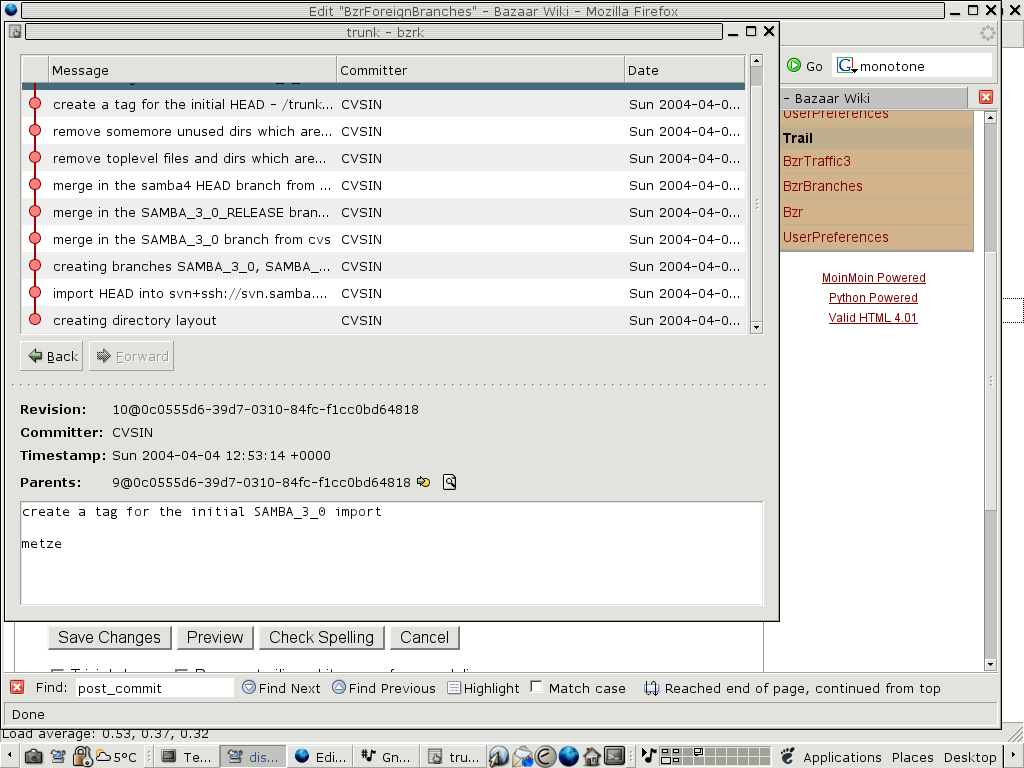
Today I spent some time working again on foreign branch support for bzr. I got quite far, and can now run ‘bzr log’ and ‘bzr viz’ on remote Subversion branches.
The big hurdle to take were the Python bindings for Subversion, which are a pain to work with. Because these bindings were generated with SWIG (and haven’t had enough customization by humans), they very much look like C functions that can be called from python. The programmer has to worry about memory management, some functions with callback methods can not be used and passing an incorrect parameter usually results in a segmentation fault.
Most commands appear to run very slowly, but I found out this was caused, while I had initially blamed bzr, by ‘svn ls’ being extremely slow. It takens up to a few minutes to get a list of all files in a repository. This is of course a big problem if you’re trying to generate 2000 inventory objects, one for each revision….
While trying to work on foreign branch support today, I got distracted and hacked up a small post-commit hook for bzr that submits commits to CIA. Doing stuff like this is trivial to do with bzr if you know some python.
Wilmer announced the switch of Bitlbee’s source control system to bzr yesterday, so it’s finally official. This will hopefully make it easier for Maurits and me to contribute, and increase the number of external contributors.
Since we’ll be using trac as the bug tracking system for BitlBee and bzr for source control, we won’t be able to use the default post-commit-message-hook, which comes with trac. This script usually makes sure that whenever a commit is done that references a bug, this gets mentioned on the page of that particular bug in trac.
I’ve hacked up a quick plugin for bzr which implements the same thing for the combination of bzr and trac. This isn’t the ideal solution since it requires that the script is running on the same host as the trac server, which is sometimes not the case as people push changes to their server rather then log in to their server and merge and commit the changes from their workstation.
The proper fix is probably getting trac itself to get information like this from the commit messages. It already detects new commits (they are shown in Timeline) and knows how to parse them, so something like that shouldn’t be very hard to implement.
After three years without, it looks like BitlBee is finally going to leave the dark ages and use a version control system that was not thought up in Wilmers’ basement. Up until now, Wilmer kept a master copy of the tree from which he generated nightly snapshots. The other two developers (Maurits and me) would then send patches against those nightly snapshots which Wilmer would apply. This sort of worked, but it wasn’t ideal: migrating in-progress patches from snapshot to snapshot takes a lot of time and creating incremental patches can be impractical as well.
Some of the objections Wilmer had against using a version control system, in particular CVS and Subversion (which I was originally trying to sell him) were the fact that they require a manual svn add for all files you create, a svn rm for files you delete and the requirement for setting up a special server. At the moment, we’re experimenting with bzr since it doesn’t have these limitations.
We’re probably going with trac+darcs for the new bug tracking system.